People as a business accelerator.
I’m Brad Wilkins. For almost twenty years I’ve built and run People functions the way operators run a business — instrumented, accountable, tied to revenue, valuation, and retention, from seventy-five employees to seventy-five hundred. That’s the résumé version. The fuller version is that I’ve spent those years showing up early to shifts the field called premature, and thinking about this work from angles most of it hasn’t reached yet — shaped as much by a basketball whistle, a theater degree, and two kids as by any operating model. Everything here has been built and run. None of it is a theory I haven’t shipped.
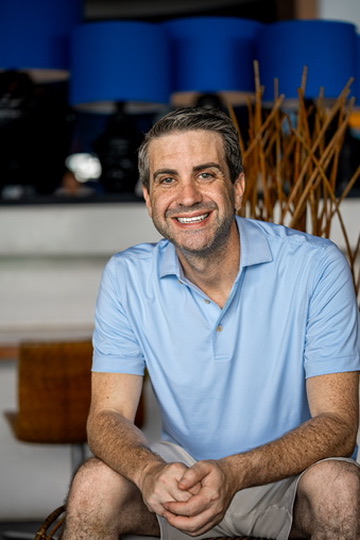
Brad embodies what every business leader wants and needs, but rarely gets: a business oriented, progressive and strategic HR leader.
Marcello Mastioni — COO, Loadsmart & Altisource · Expedia, HomeAway, Vrbo
Accelerator. Builder. Architect.
An operating function, not a support function
I run People as an operating lever tied to the numbers a board actually tracks — org design, talent, and rewards built to move valuation and retention, with the people analytics to make every decision defensible. If your people strategy can’t survive contact with a CFO, it isn’t a strategy.
Built 0-to-1. Proven at scale.
HR, Talent, and Performance infrastructure built from scratch and scaled globally — through hypergrowth, restructuring, acquisition, and public-company scrutiny. The systems outlast the tenure, and so do the leaders who run them.
AI-native by design
I architect how the People function runs on AI — the cheesecloth for every workflow, a prove-the-negative default, and agents as a third column on the org chart with charters and owners. Underneath it sits a seven-layer governance stack borrowed from the enterprise standard, not invented for HR. The line stays bright: where agents decide, where they recommend, and where a human must.
Managers. Individual contributors. Agents.
The org chart of 2018 had two columns. The org chart of 2028 has a third — agents with charters, owners, and performance expectations. You can already be an individual contributor with six direct reports, all of them agents. Someone has to draft the rules for that world: where agents decide, where they recommend, and where a human must.
Systems, not takes.
There is no shortage of opinion about the future of the People function. There is a shortage of people who have built the thing and can show you the tables. What’s here is the second kind: a diagnostic you can run on your own function, nine frameworks with the arguments intact, and a record with the numbers attached. It doesn’t update weekly. It updates when something new has actually been built.
People Function Pillars
A maturity assessment for the People function — six pillars, a 0–4 rubric, six size bands, and AI as a layer rather than a box.
Nine frameworks
The cheesecloth, prove the negative, the third column, the governance stack, impact over performance — each with where it came from.
The record
Five companies, twenty years, and the numbers each one moved — including which figures are public and which are mine to stand behind.
On the record.
House, whistle, stage, storybook.
I grew up in a house that fostered more than 150 kids, run by two parents who were both CEOs — people and business were never separate subjects. Basketball referee trained by the best officials in the game, with a past NBA tryout to show for it. Children’s-book author (Let’s Go Bananas). Theater-trained, which explains more about how I lead than any certification. Dad of two in Atlanta.