People Function Pillars.
Most “assessments” of a People function are a downloaded maturity chart and a gut feeling. I built something I could defend in front of a CFO. Six pillars. Every pillar has a North Star — what great actually looks like — and underneath it, the specific building blocks that get you there. Each one scored on whether the artifact exists, whether the practice is actually followed, whether the outcome is measurable — and now, whether it was designed AI-native or bolted on. Not “do you have a performance process.” Is it practiced, can you prove it changed anything, and would you build it that way today. And it scales — what’s world-class for a 200-person company is negligent for a 3,000-person one, so the bar moves with your size.
AI is a layer, not a pillar.
Older models isolate AI as one box on the chart, which quietly signals it’s a specialty someone else owns. Here, every pillar has explicit AI integration points, and the technology pillar covers the spine — data, governance, and analytics — not “where AI lives.” AI isn’t a station on the org chart. It’s the electricity.
Each with a North Star — what “great” actually looks like.
Sequenced deliberately: org design leads, because the org chart is the product. Tech, Data & AI anchors the list — not as an afterthought, but as the spine the other five stand on.
Org Effectiveness
The right people in the right roles, organized for fast decisions and sustained performance, with a leadership pipeline ahead of business need.
Modernization: workforce planning is a quantitative function, not a headcount spreadsheet — and increasingly a statement of combined human-and-agent capacity. Reviews are AI-drafted and human-owned, measuring what the work changed rather than what the person did. Talent reviews produce decisions, not discussions. Re-orgs are measured for outcome, not just executed.
Talent Acquisition
Attract, assess, and acquire the right talent at the right cost, with predictable quality — in a hiring market reshaped by AI on both sides of the table.
Modernization: pipelines are continuous, not requisition-triggered. Structured interviews with calibrated rubrics are the floor. Identity verification is now a hiring concern, because deepfake candidates and AI-generated résumés are real. AI screening runs with continuous bias auditing and a human in the loop — and 90-day outcomes write back into the front of the process, because every hire is a prediction and almost nobody grades it.
Total Rewards & Recognition
Pay people fairly, transparently, and competitively for the work they do — with rewards that scale with business outcomes, not tenure.
Modernization: pay equity is continuous, not annual. Comp decisions are AI-recommended and human-approved. Posted ranges are the floor of transparency, not the ceiling. Equity refresh strategy retains the people you can’t afford to lose.
Culture & Engagement
A culture where the right people choose to stay and do their best work — measured continuously, owned by managers, and expressed in real behavior.
Modernization: annual surveys are obsolete as the primary signal; continuous listening with privacy guardrails replaces them. Managers own engagement — the People function provides leverage, not absolution. Belonging is measured by outcome, not by event count.
Core HR & Compliance
A function that runs with operational excellence and legal defensibility — invisible when it’s working, and never the reason a business decision is blocked.
Modernization: AI handles tier-one inquiries; HR handles judgment. Compliance is continuous monitoring, not an annual audit. Employee-relations cases are pattern-detected, not individually triaged. People ops is a service organization, not a ticket queue.
Tech, Data & AI
A People function operating with the data discipline of finance and the AI integration of a product team — predictive, automated where it should be, and trusted with the data it holds.
Modernization: the spine. Unified data, vendor evaluation as a discipline, bias auditing as non-negotiable, employee transparency as non-negotiable. It’s also where the governance stack lives in practice, and where agents get org-chart boxes with charters, owners, and budget accountability.
Scored against where you’re going, not where you are
Six maturity levels, from a 1–50-person startup to a 3,000-plus enterprise. Every building block scored 0–4 — Absent, Emerging, Defined, Practiced, Effective — against your target maturity, not just your current state. The top score requires both consistent practice and measurably good outcomes, so you can’t four your way through a self-assessment on vibes.
Concept — does the artifact exist? A deliberate, documented design someone could follow without asking you.
Action — is the practice actually followed? Documented-and-dormant is the single most common failure in HR, and this framework is built to catch exactly that.
Effectiveness — is the outcome measurable? Running is not the same as working. Has the measure ever changed a decision?
Leverage — was it designed AI-native, or is it the 2019 process with a chatbot in front of it? The newest dimension, and the one that changes the most conversations. A building block can score well on the first three and near-zero here, and that is the most expensive kind of good.
The gaps between dimensions are the diagnosis. Concept far above Action means an adoption problem, not a design problem. Action far above Effectiveness means you’re doing things without knowing whether they work. Effectiveness above Concept means it works but it’s fragile — losing one person breaks it. Each pattern turns into a sequenced roadmap: now, next, later.
What a real assessment looks like.
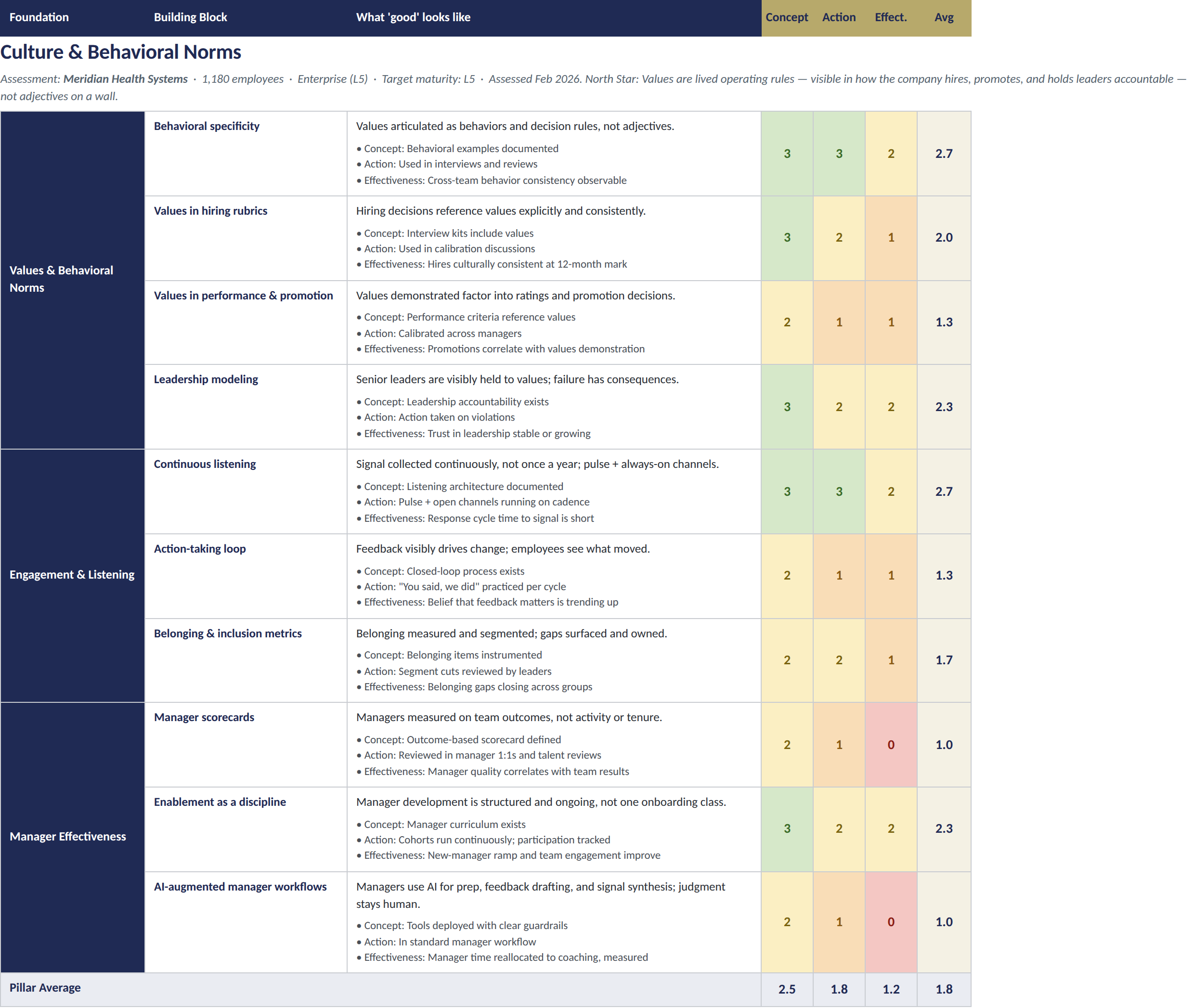
A slice of the working scorecard — every building block scored against target maturity, rolled into a sequenced roadmap.
Want a clear read on where your People function actually stands?
I use this framework to diagnose and rebuild People functions — my own, and others’. If you’re a founder, an investor, or a People leader who wants a defensible read on where your function stands against where your business is going, that’s a conversation I’m glad to have.